February 10th, 2026
|
Share with
Water is the most critical survival resource. You can live three weeks without food, but only three days without water. Yet most families have less than a day’s worth of drinking water stored.
In emergencies – hurricanes, earthquakes, winter storms, infrastructure failures – water service can stop instantly. Contamination, power outages, or broken pipes mean no safe water when you need it most.
The solution is simple: store your own water. Here’s everything you need to know.
How Much Water Do You Need?
Minimum: 1 gallon per person per day
Recommended: 2 gallons per person per day
Why 2 Gallons?
- 1 gallon for drinking
- 1 gallon for cooking, hygiene, medical needs
Family Calculations:
For 3 days (bare minimum):
- 1 person: 3-6 gallons
- 2 people: 6-12 gallons
- Family of 4: 12-24 gallons
For 2 weeks (recommended):
- 1 person: 14-28 gallons
- 2 people: 28-56 gallons
- Family of 4: 56-112 gallons
Don’t forget pets: 1 ounce per pound of body weight per day
- 50 lb dog = 1.5 quarts per day
Best Water Storage Containers
Not all containers are safe for water storage. Some leach chemicals, others grow bacteria.
✅ Safe Options:
1. Store-Bought Bottled Water
- Pros: Convenient, pre-sealed, portable, affordable
- Cons: Takes up space, plastic waste
- Best for: Getting started quickly
- Cost: $0.20-0.40 per gallon
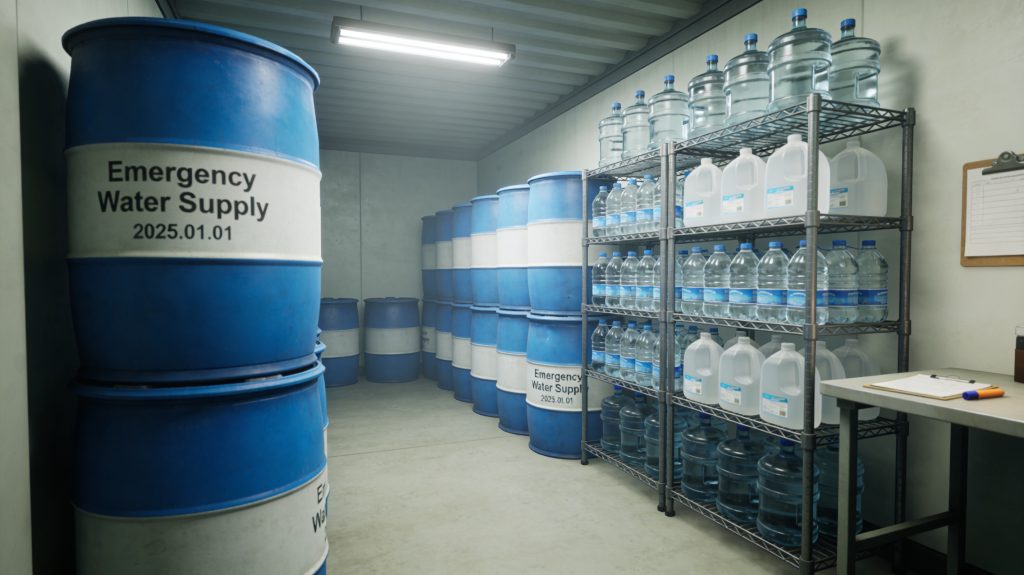
2. Food-Grade Water Barrels
- Pros: Large capacity, space-efficient, long-term storage
- Cons: Heavy when full, needs space
- Best for: Serious preppers with storage room
- Sizes: 15, 30, 55 gallons
- Cost: $50-100 for 55-gallon
3. Collapsible Water Containers
- Pros: Stores flat when empty, BPA-free, portable
- Cons: Less durable than rigid containers
- Best for: Limited space, bug-out bags
- Sizes: 2.5-10 gallons
- Cost: $10-30
4. Glass Jars
- Pros: Doesn’t leach chemicals, reusable, free (from food)
- Cons: Heavy, breakable, small capacity
- Best for: Supplementing other storage
- Cost: Free (reuse pasta sauce jars, etc.)
❌ Avoid These:
Milk Jugs
- Plastic breaks down quickly
- Impossible to clean completely (bacteria grows)
- Thin plastic cracks easily
Containers That Held Non-Food Items
- Chemicals can’t be fully removed
- Never safe for drinking water
How to Store Water Safely
Step 1: Choose Your Container
Use food-grade plastic (look for #1, #2, #4, or #7 on bottom) or glass.
Step 2: Clean Thoroughly
Even new containers need cleaning:
- Wash with dish soap and water
- Rinse completely (no soap residue)
- Sanitize with 1 teaspoon bleach per quart of water
- Let sit 10 minutes
- Rinse again with clean water
Step 3: Fill with Clean Water
If using tap water: Fill directly (municipal water is already treated)
If using well water: Add 8 drops of unscented bleach per gallon
Filling tips:
- Fill to the very top (minimize air exposure)
- Screw cap on tight
- Don’t touch inside of container or cap
Step 4: Label and Date
Use permanent marker:
- Date filled
- “Drinking Water”
- “Do Not Open Until Emergency”
Step 5: Store Properly
Best Locations:
- Cool, dark place (basement, closet, under bed)
- Away from direct sunlight
- Off concrete floor (use wood palette or plastic shelf)
- Away from gasoline, chemicals, paint
Temperature:
- Ideal: 50-70°F
- Avoid freezing (cracks containers)
- Avoid heat (breaks down plastic)
How Long Does Stored Water Last?
- Commercially bottled water: 1-2 years (check expiration date)
- Home-stored tap water: 6-12 months
- With bleach treatment: Up to 5 years (but rotate annually to be safe)
Truth: Water doesn’t go “bad,” but:
- Plastic can leach chemicals over time
- Containers can crack or leak
- Taste may change (flat, stale)
Best practice: Rotate every 6-12 months
- Pour old water on lawn/plants
- Refill with fresh water
- Repeat
Purifying Stored Water (If Questionable)
If your stored water looks, smells, or tastes odd, purify before drinking:
Method 1: Boiling (Most Reliable)
- Bring to rolling boil for 1 minute (3 minutes above 6,500 ft elevation)
- Cool before drinking
- Pour between containers to improve flat taste
Method 2: Bleach
- Regular unscented bleach (6% sodium hypochlorite)
- 8 drops per gallon clear water
- 16 drops per gallon cloudy water
- Mix, let sit 30 minutes
- Should smell faintly of chlorine
Method 3: Water Filters
Keep portable water filters as backup.
Budget Water Storage Plans
$0 Budget (Free Start):
- Save 2-liter soda bottles (rinse well)
- Fill with tap water
- Label and store
- Result: 10-20 gallons free
$20 Budget:
- 4 cases bottled water (96 bottles = 12 gallons) – $20
- Result: 3-day supply for 1-2 people
$50 Budget:
- 8 cases bottled water (24 gallons) – $40
- Water purification tablets (backup) – $10
- Result: Week supply for 2 people
$150 Budget:
- 55-gallon barrel – $80
- Siphon pump – $15
- Water treatment (stabilizer) – $15
- Cases of bottled water (portable backup) – $40
- Result: Month+ supply for family of 4
Water Storage Mistakes to Avoid
❌ Storing Only in One Location
If that area floods/becomes inaccessible, you lose everything.
Solution: Split supply between locations (home, car, shed)
❌ Forgetting to Rotate
Old water may taste bad or have bacterial growth.
Solution: Set phone reminder every 6 months
❌ No Purification Backup
What if you run out of stored water?
Solution: Keep filters and purification tablets
❌ Using Contaminated Containers
Milk jugs, chemical containers are never safe.
Solution: Only use food-grade containers
❌ Storing on Concrete
Concrete leeches chemicals into plastic.
Solution: Use wooden palettes or plastic shelving
Beyond Storage: Alternative Water Sources
If you run out of stored water, know where to find more:
In Your Home:
- Water heater (30-50 gallons) – drain from bottom valve
- Toilet tank (NOT bowl) – clean water before contamination
- Ice cubes in freezer
- Canned fruits/vegetables (drain liquid)
Outside Your Home:
- Rainwater (purify before drinking)
- Streams, rivers, ponds (MUST purify)
- Swimming pools (purify before drinking)
- Snow/ice (melt and purify)
Always purify water from these sources – don’t risk illness.
Your Water Storage Action Plan
Week 1: Start Small
- Buy 2-3 cases bottled water
- Store in closet or under bed
- Cost: $10-15
Week 2: Add Purification
- Buy water filter or purification tablets
- Keep with stored water
- Cost: $10-25
Week 3: Expand Storage
- Add 3-4 more cases OR invest in larger containers
- Cost: $15-80
Week 4: Organize and Label
- Label all containers with date
- Create storage location map
- Set rotation reminder
- Cost: $0
In one month, you’ve built a solid emergency water supply.
Final Water Storage Checklist
- ✅ Calculated family water needs (2 gallons/person/day)
- ✅ Chose appropriate containers (food-grade only)
- ✅ Cleaned and sanitized containers
- ✅ Filled with clean water
- ✅ Labeled with date
- ✅ Stored in cool, dark location
- ✅ Set rotation schedule (every 6 months)
- ✅ Have purification backup (filter or tablets)
- ✅ Know alternative water sources
- ✅ Have extraction tools (siphon, bucket, rope)
Your turn: Storing water is one of the first steps in real preparedness. Get the free 7 Days Emergency Plan below and follow a simple, day‑by‑day checklist that includes water, food, and more.