February 17th, 2026
|
Share with
Hunger doesn’t kill you quickly – but it weakens you, clouds judgment, and destroys morale. In extended survival situations, finding food becomes critical not just for calories, but for maintaining the mental and physical strength to survive.
This guide teaches realistic food procurement methods for true wilderness survival – not TV survival shows.
The Brutal Truth About Wilderness Food
Reality check:
- Finding enough calories to sustain yourself is HARD
- Most wild foods are low-calorie
- Hunting/trapping requires significant energy investment
- You can survive 3 weeks without food (but you’ll be weak after days)
Energy math:
- Average person needs 2,000+ calories/day
- Wild greens: ~20-50 calories/cup
- You’d need to eat pounds of greens to survive
Takeaway: Prioritize high-calorie foods – fish, game, nuts, roots over leafy greens.
Food Procurement Priority List
Best calorie sources (ranked):
- Fish – Abundant, high protein/fat, easier to catch than game
- Small game – Squirrels, rabbits, birds
- Insects – High protein, abundant, easy to catch
- Nuts – High calorie, easy to gather (seasonal)
- Roots/tubers – Carbs, energy
- Large game – High reward but high energy cost
- Wild edibles – Vitamins but low calories
Spend effort where reward is highest.
Method 1: Fishing (Best Survival Food Source)
Why fishing wins:
- Fish are abundant in most water sources
- Easier than hunting mammals
- Less energy expenditure
- Multiple capture methods
- High protein and fat
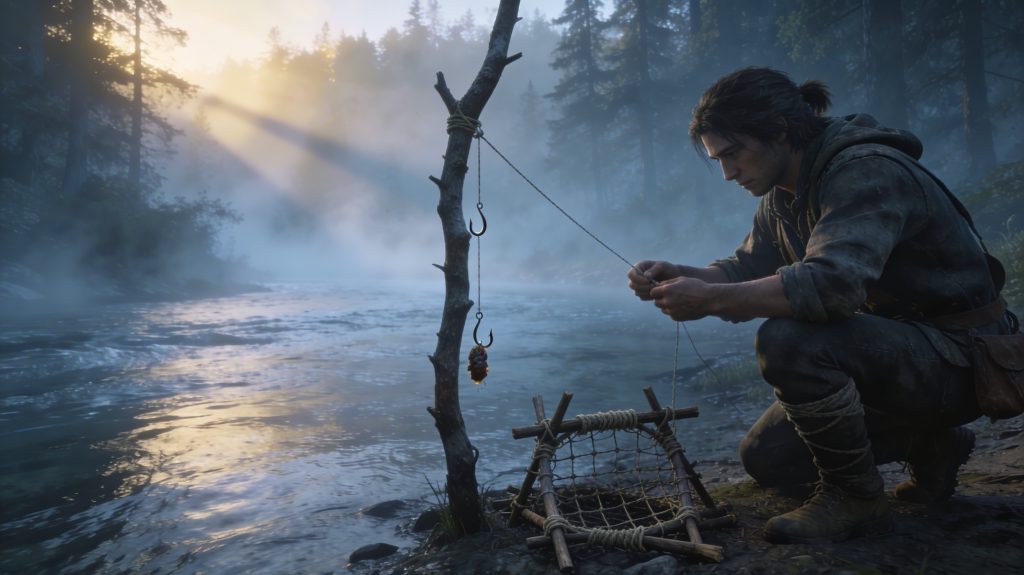
Improvised Fishing Techniques
Gorge Hook (Primitive Method)
What you need: Sharp stick or bone
How it works:
- Sharpen stick to point on both ends (1-2 inches long)
- Tie line to middle of stick
- Bait stick, fish swallows it
- Stick turns sideways in throat, can’t escape
- Pull in fish
Materials: Carved bone, wood, thorns
Trotline (Passive Fishing)
What you need: Long line, multiple hooks (or improvised gorges)
How to set:
- Stretch line across stream (bank to bank or stake to stake)
- Attach shorter lines with hooks at intervals (18-24 inches apart)
- Bait hooks
- Check every few hours
Advantage: Fishes while you do other tasks
Hand Fishing (Noodling/Trout Tickling)
How it works:
- Find fish hiding under bank, rocks, logs
- Slowly reach hand underneath
- Gently tickle belly (calms fish)
- Grab firmly and throw on bank
Species: Works on catfish, trout
Risk: Catfish have spines, snapping turtles bite, be careful
Spear Fishing
Make spear:
- Cut straight sapling (6-8 feet)
- Split end into 4 sections (6 inches down)
- Wedge splits open with cross-sticks
- Sharpen each prong
Technique:
- Strike from above
- Aim lower than fish appears (refraction)
- Pin to bottom, don’t try to “spear through”
- Works best in shallow, clear water
Fish Traps (Best Passive Method)
Funnel trap:
- Weave cone-shaped basket from branches
- Point narrow end inward
- Fish swim in, can’t find exit
- Weight down in stream
Takes time to build but works overnight
Bait Options
Best baits:
- Worms, grubs (dig in moist soil)
- Insects (grasshoppers, beetles)
- Small fish (use as bait for larger fish)
- Fish guts/eyes
- Berries
- Grubs from rotten logs
Method 2: Trapping Small Game
Why trapping beats hunting:
- Works 24/7 (passive income)
- Requires less energy than active hunting
- Set multiple traps = multiple chances
Reality: Trapping requires knowledge, practice, and patience. Success rate is low without experience.
Deadfall Trap (Primitive but Effective)
Best for: Squirrels, rabbits, mice
Basic design:
- Heavy flat rock or log (deadfall)
- Prop up with figure-4 trigger system
- Bait under deadfall
- Animal disturbs trigger → deadfall crushes prey
Figure-4 trigger (critical component):
- Three sticks notched to interlock
- Requires practice to carve properly
- Search “figure-4 deadfall trigger” for diagrams
Placement: Along game trails, near burrows
Snare Trap (Wire or Cordage Loop)
Best for: Rabbits, squirrels
How to make:
- Create 4-inch diameter loop with wire or cord
- Attach to tree/stake
- Position loop on game trail at head height of target animal
- Animal runs through, loop tightens
Placement:
- Active game trails (look for tracks, droppings)
- Fence crossings
- Log crossings over streams
- Den/burrow entrances
Materials:
- Brass snare wire (best)
- Paracord inner strands
- Plant fiber cordage
Check traps twice daily – don’t let animals suffer unnecessarily
Method 3: Hunting
Reality check: Hunting without a firearm is extremely difficult and energy-expensive.
- Sling/Rocks: Practice required, effective range 20-30 feet, target birds and squirrels
- Throwing sticks: Heavy stick (2 feet long), throw at rabbits/birds, aim for legs
- Primitive bow: Time-intensive to make, requires practice, low power
- Clubs: Last resort, need to get very close
- Atlatl: Increases spear range, requires practice, proven historical design
Method 4: Insects (Don’t Knock It)
Protein reality: Insects have more protein per ounce than beef.
Best edible insects:
Grasshoppers/Crickets
- High protein
- Easy to catch in morning (sluggish when cold)
- Remove legs and wings, roast
Ants
- Abundant, protein-rich
- Avoid red/fire ants (painful sting)
- Roast to remove formic acid
Grubs
- Found in rotten logs
- High fat and protein
- Eat raw or cooked
Termites
- Break open rotten wood
- Very high protein
- Tastes like nutty greens
Worms
- Squeeze out dirt first
- Cook or soak to remove grit
AVOID:
- Brightly colored insects (often toxic)
- Insects that smell bad
- Hairy caterpillars
- Spiders (some venomous)
- Disease-carrying insects (flies, mosquitoes)
Cooking: Roasting improves taste and kills parasites
Method 5: Foraging High-Calorie Plants
Calorie-dense wild foods:
Nuts (Fall Season)
- Acorns (must leach tannins)
- Hickory nuts
- Black walnuts
- Pine nuts
- Hazelnuts
Roots and Tubers
- Cattail roots (starchy)
- Arrowhead tubers (potato-like)
- Jerusalem artichoke
- Wild onions
Seeds
- Amaranth
- Lamb’s quarters seeds
- Sunflower seeds
Berries (Summer)
- Blackberries, raspberries, blueberries
- High sugar but low fat
All require positive identification
Method 6: Opportunistic Scavenging
Don’t ignore:
- Eggs from bird nests (spring)
- Freshwater mussels/clams (boil thoroughly)
- Crayfish (boil, eat like lobster)
- Frogs (legs are edible, tastes like chicken)
- Turtles (meat inside shell – all edible)
Scavenging dead animals:
- Only if fresh (hours old, not days)
- Check for maggots (if present, it’s too far gone)
- Must cook thoroughly
- High risk of disease
- Desperate measure only
Cooking and Food Safety
Why cook everything:
- Kills parasites (common in wild game and fish)
- Kills bacteria
- Easier to digest
- Improves taste
Cooking methods:
- Boiling (safest): Brings water to 212°F, kills everything
- Roasting: Direct on coals or stick over fire
- Hot rock cooking: Heat rocks in fire, drop in water container
- Stone griddle: Flat rock over fire
- Smoking: Preserves meat, takes hours/days
Preservation (Making Food Last)
- Smoking: Hang meat above smoky fire 12-24 hours, keeps for weeks
- Drying (jerky): Cut thin strips, hang in sun, completely dried = preserved
- Freezing (winter): Bury in snow, keeps indefinitely in cold
- Salting: Cover meat in salt, draws out moisture
Energy Conservation Reality
Important calculation: Calories spent hunting/gathering vs. calories gained
Example:
- You burn 200 calories hiking to fishing spot
- You catch 300 calories worth of fish
- Net gain: Only 100 calories
Be strategic:
- Focus effort where reward is highest
- Don’t exhaust yourself for minimal gain
- Passive methods (traps, fishing) are more efficient
Legal and Ethical Considerations
Know before you go:
- Trapping/hunting regulations vary by location
- Survival situations may override regulations (check your jurisdiction)
- Practice techniques BEFORE emergency (with proper licensing)
Ethics:
- Don’t waste meat
- Minimize suffering
- Only take what you need
- Respect wildlife
Practical Skills to Learn Now
Practice these legally:
- Fishing with improvised hooks
- Carving figure-4 triggers
- Identifying edible plants in your region
- Building fish traps (check local laws)
Don’t wait for starvation to learn these skills.
Conclusion
Wilderness food procurement is about efficiency: maximize calories gained while minimizing calories spent. Fish and traps provide the best return on effort. Insects are underrated. Wild greens won’t sustain you long-term.
The most important survival food is the one you brought with you. Carry extra calories when heading into wilderness. These techniques are backup plans, not primary strategies.
Hunger sharpens focus. Knowledge fills the belly.
Your turn: When food runs low, knowing how to find calories is only half the battle. Grab my free 7 Days Emergency Plan below so you’re not starving in the first place when crisis hits.